
I am working on a board game at the moment. It is still nowhere near finished but this is what I have so far.
It is called Beauty Billionaire
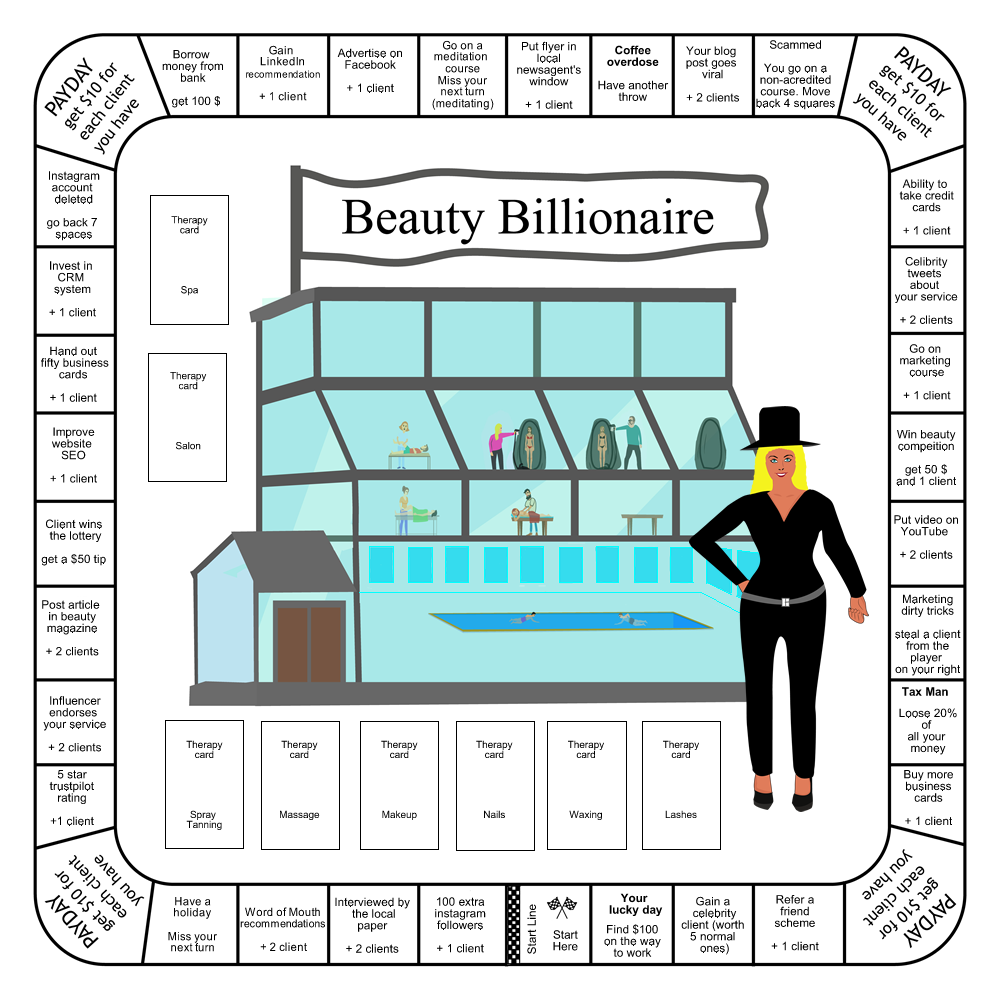
Objective of the game
Each player starts off as a mobile therapist of one six types. The objective of the game is to get more clients which leads to more money. The money can be spent on training to level up either the starting therapy of any of the other five. Money can also be spent on advertising to gain more clients. When you have a thousand beauty dollars you can buy a salon (to a maximum of three). When you have three salons and five thousand beauty dollars you can purchase a spa and win the game.
Setup phase
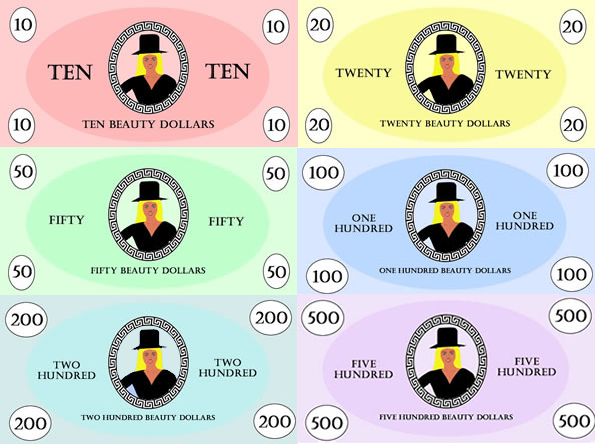
Each player decides which therapist they want to play – Tina Tanner, Michelle Masseuse, Mary Makeup, Naome Nails, Wendy Wax or Lisa Lashes and places the appropriate player mat in front of them. If two (or more) players want the same character then they roll the dice, the highest roll choosing first. Roll again in the event of a tie. Place one glass counter on level one of your starting therapy. Each player starts the game with 3 clients and 100 Beauty dollars. Money and clients must be kept on the player mat in sight of everyone but you do not have to tell anyone how much money you have (although you might choose to count it out publicly when it comes to trading and this is allowable).
To decide who starts
Roll two dice and the player with the highest score starts the game (by rolling again, they do not get to reuse the roll that won them the right to start first). Play continues in a clockwise direction.
Order of play
Roll, move (and consequence), pickup cards, trade, invest, throw excess cards
You start (not surprisingly) on the start square. Roll two dice and move that many squares in a clockwise direction. In the standard game it is permissible to land on a square already occupied by another player and this has no effect.
Each square has some effect, usually beneficial and usually gaining you more clients. Take the number of clients that the square gives you and place them on your mat, or follow any other instructions (such as getting money, losing a turn etc.) Payday (getting money from your clients) only happens when you land on the corner square, you do not get money for just passing it.
Having followed the instructions on the square you have landed on, if you rolled a double then you must take a second go and follow the instructions on the subsequent square that you land on. If the second roll is also a double then, having followed the instructions on that square you roll again. There is no limit to the number of turns you can have if you keep rolling doubles (and no ending up in jail).
When you have finished rolling the dice and following the square instructions you can then pick up a card for every level of every therapy you are qualified in. Starting as a level one Nail tech you would pick up one card from the nail pile. Later on in the game if you were level three nails, level two in tanning and lashes and level one in massage you would pick up 3 nail therapy cards, 2 tanning and lash cards and one massage card etc. If you own any salons you pick up the same number of salon cards as the number of salons that you own.
I have not finished all of the therapy cards yet but what I have (which is most of them) is here Hopefully anyone with this link can comment so feel free to do so if you can think of any other events I can put in there.
You do not have to show your cards to anyone but you might choose to. This is the trading phase. You may trade or sell any cards you hold in your hand. It is permissible for another player to ask you to trade during your trading phase. It is not permissible for another player to instigate a trade with anyone else during your trading phase. The most obvious reason for trading is to acquire enough points in a second therapy to level that therapy up. There is also a limit of seven cards you can hold in your hand so if you have the opportunity of selling surplus cards for money rather than having to discard them, that might (or might not) be appropriate.
When all trading has finished you may invest any money you have in training, marketing or property. If you have $100 and three cards of the same therapy you may level up that therapy. You may only level up one therapy per turn. Alternatively, or additionally, you may spend as much money as you choose on marketing. Spending $50 will get you one more client. As well as these if you have a thousand beauty dollars you can buy a salon (to a maximum of three but only one per turn) and if you have own three salons and hold five thousand beauty dollars you can purchase a spa and win the game.
At the end of the investment phase you must discard any cards that bring the number of cards in your hand to over seven. You can decide which cards to keep and which to discard but you can not end your turn holding more than seven cards.
The turn then passes to the player on your right.
Game variations
There are currently two variations of the rules that increase the complexity of the game. The ‘two way street’ variation and the ‘double and pass’ variation. If agreed by all players before commencement of the game then either or both of these variations can be incorporated as part of the game.
Two Way Street
You still start on the start square. You can move in either direction BUT you must state before rolling the dice which direction you are going in, If you do not do this you will be made to go clockwise
The far edge of the board will have larger rewards but also larter perils whereas the starting edge will be the safer (but less profitable) option
If your roll lands you on another player then you must move that other player’s pawn one square to the left or right. It is up to you which way you move them. You can do this to help them or to hinder them, you can make (and to a large degree break) deals and promises. ‘Present’ (or transaction) deals need to be honored, so (for instance) if you make a deal that you will move them left if they give you $50 then they do have to give you the $50 and you do have to move them left. Future (or promissory) deals such as ‘if I let you choose this time, then you must let me choose next time’ are not enforceable and can be broken.
If a player that has been moved one square like this lands on a third player then the third player’s pawn must be moved one square in the same direction that the second player was moved (to prevent them ending up in the square occupied by the original player. It is quite acceptable for the original player to make a deal with this third player, requesting some reward for getting them moved to an advantageous square but because technically it is the second player that moved the third, this would be a future deal and thus unenforceable.
Double and pass
Every time a double is rolled every player passes one therapy card of their choice to the player on their right.
This will speed the game up as it will make it much easier to obtain your second therapy and will make it more dangerous to hold on to prime therapy cards (such as the +1 in any therapy)